A Practical Guide to Foreigner Registration, Residence Cards, Required Documents, and Address Changes in Korea
If you’re moving to Korea for more than 90 days — for work, study, marriage, or a long-term visa — registering as a foreign resident isn’t optional. It’s the single most important piece of paperwork you’ll handle after landing, because almost everything else (opening a bank account, signing a lease, getting a phone plan, even picking up a package) depends on having your registration in order.
Here’s what’s changed and what still holds true heading into 2026.
Who Needs to Register
You must register if you:
- Are a foreign national planning to stay in Korea for more than 90 days
- Renounced Korean nationality, now hold a foreign nationality, and plan to stay more than 90 days
- Were born in Korea as a foreign national and plan to stay more than 90 days from the date your visa status is granted
This covers the vast majority of people on long-term visas: students (D-2, D-4), workers (E-1 through E-7, E-9, H-2), and long-term residents (F-2, F-4, F-5, F-6), among others.
Who’s Exempt
You don’t need to register if you hold:
- A diplomatic (A-1), official (A-2), or treaty (A-3) visa, including immediate family
- A role in important diplomatic, industrial, or defense-related work recognized by the Ministry of Justice
- Canadian citizenship and are staying less than 6 months under specific visa types (D-1 Artist, D-6 Religion, F-1 Visiting Family, F-3 Accompanying Spouse, G-1 Miscellaneous)
- Registered status as a foreigner under age 17 (registration becomes mandatory within 90 days of turning 17)
When to Register
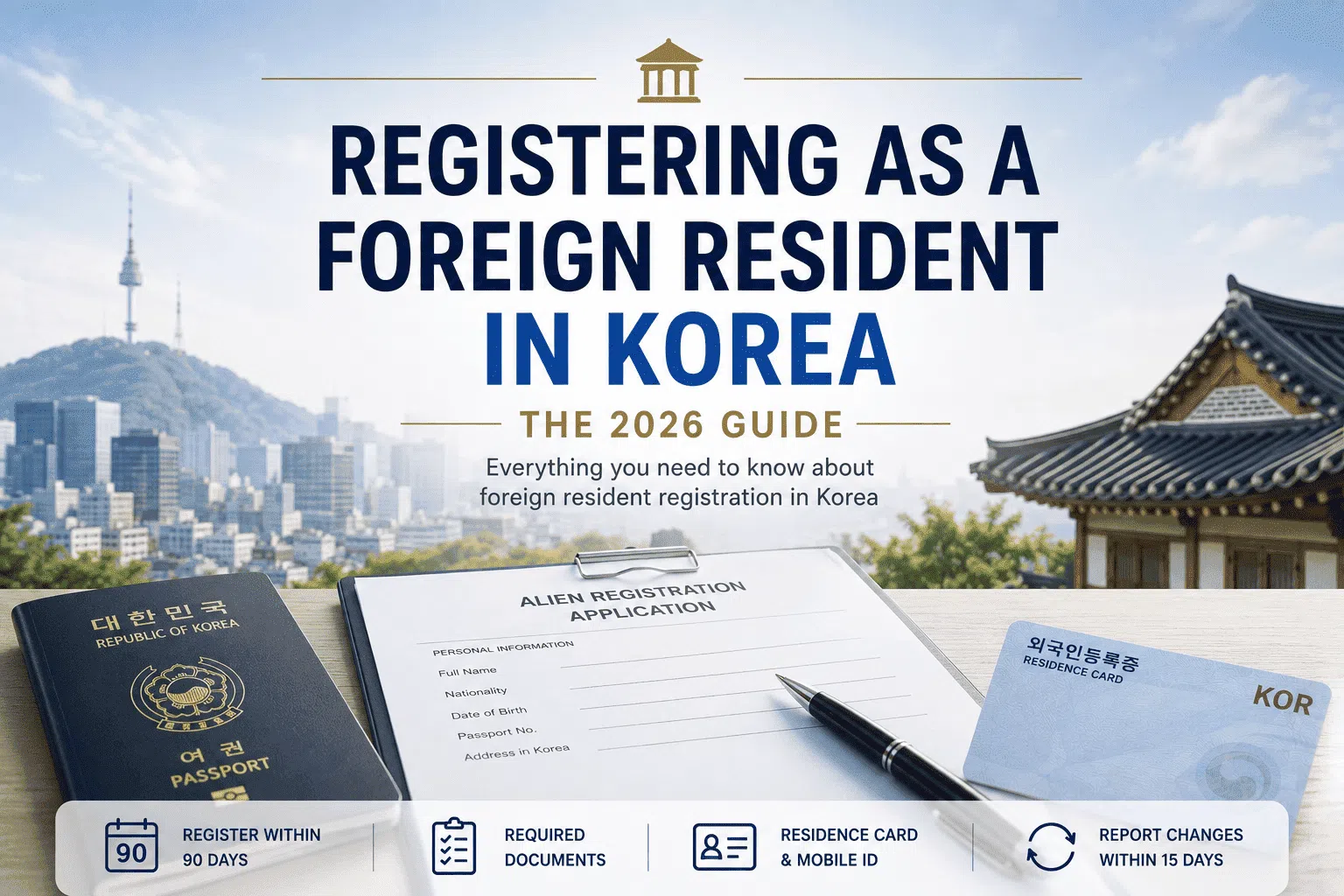
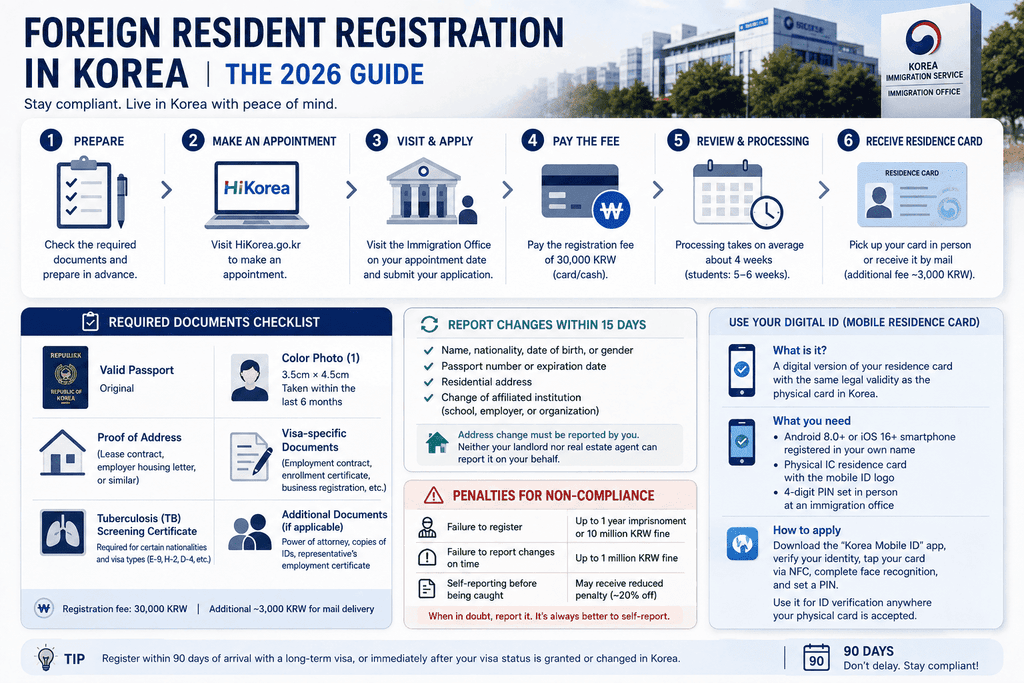
- Entering with a long-term visa: register within 90 days of arrival.
- Changing or being granted a visa status while already in Korea: register immediately after approval — don’t wait.
Immigration offices get busy, especially around university semester starts, so book your HiKorea appointment early rather than waiting until day 85.
Required Documents
- Application form (available at immigration offices or via HiKorea)
- Valid passport
- One color photo, 3.5cm × 4.5cm, taken within the last 6 months
- Proof of address (lease contract, employer-provided housing letter, or similar)
- Visa-specific documents (employment contract, enrollment certificate, business registration, etc. — this varies significantly by visa type)
- Nationals of countries with a high tuberculosis burden may need a TB screening certificate for certain visa categories (E-9, H-2, D-4, and others)
- Registration fee: 30,000 KRW (an additional ~3,000 KRW applies if you request the card be mailed to you rather than picked up)
- If applying through a representative: power of attorney, copies of both parties’ ID, and the representative’s employment certificate
Processing typically takes about 4 weeks, though student registrations can run 5–6 weeks. Plan around this if you need the card for a bank account or phone contract.
Reporting Changes
Once registered, you’re required to report certain changes to your local immigration office. As of 2026, the standard window is within 15 days of the change. This includes:
- Name, nationality, date of birth, or gender
- Passport number or expiration date
- Your residential address
- A change of affiliated institution (new school, employer, or organization)
A note for renters specifically: if you move, only you — not your landlord or real estate agent — can file the address change report. A landlord has no legal standing to submit it on a tenant’s behalf, so don’t assume your agent or landlord will “take care of it” as part of the move-in process. It’s a quick task through HiKorea or your local district office, but it’s yours to do.
Penalties for Missing a Deadline
- Failing to register at all: up to 1 year imprisonment or a 10 million KRW fine
- Failing to report a change on time: up to a 1 million KRW fine
- Self-reporting a missed deadline before immigration catches it can qualify you for a reduced penalty (roughly 20% off, under administrative procedure rules) — so if you’re late, report it anyway rather than hoping it goes unnoticed
Mobile Residence Card (Updated for 2026)
Korea’s digital residence card, first rolled out in January 2025, has matured into a genuinely useful option by 2026 rather than a novelty.
How it works:
it’s a digital version of your physical IC residence card, stored in the Korea Mobile ID app, and it carries the same legal validity as the physical card for identification purposes within Korea.
What you need:
- An Android 8.0+ or iOS 16+ smartphone registered in your own name (corporate phones, BlackBerry devices, and most MVNO carriers other than LG U+ won’t work)
- A physical IC residence card that displays the mobile ID logo
- A 4-digit PIN, which you set in person at an immigration office
How to apply:
the process is done entirely from your phone — download the Korea Mobile ID app, verify your identity, tap your physical card to the back of your phone via NFC, complete a facial recognition scan, and set your PIN.
Good to know:
- It’s tied to one specific device — switching phones means reissuing it
- Its validity always tracks your underlying physical card’s expiration
- Some older systems and smaller institutions may not yet accept it, so it’s worth carrying the physical card as backup, especially for first-time transactions at a new bank or office
- App interface is currently Korean-only
Life With Your Residence Card
Your residence card (still commonly called by its old name, the Alien Registration Card or ARC) functions as your primary ID in Korea. You’ll need it — physical or mobile — for:
- Opening a bank account
- Signing a lease
- Getting a mobile phone plan
- Getting a driver’s license
- Verifying your identity on most Korean apps and websites
When you leave Korea for good, return the card at the airport immigration counter before departure.
A Practical Note From a Seoul Rental Agent
Working with expat tenants in Seoul every day, the registration process is where I see the most avoidable stress — not because the rules are complicated, but because the timing gets tangled up with move-in dates. A few things worth knowing before you sign a lease:
- Landlords will often ask for your registration card (or at least proof you’ve applied) before finalizing a lease, since it’s tied to your legal address in Korea.
- If you’re registering for the first time and apartment-hunting at the same time, your lease contract itself usually works as proof of address for the registration application — you don’t need to wait for one to finish the other.
- Once you register your new address, keep a copy of the confirmation. Some banks, phone carriers, and even future landlords will ask to see it.
If you’re navigating a Seoul rental as a foreigner and want someone who deals with this paperwork daily, that’s exactly the kind of thing I help clients sort out alongside the actual apartment search.
Useful Resources
- HiKorea — appointment booking, applications, and change-of-information reporting
- Foreign Resident Consultation Center: ☎ 1345
- Your local immigration office (jurisdiction is based on your registered address)
This guide reflects publicly available immigration rules as of September 2026. Requirements and fees can change — always confirm details for your specific visa type on HiKorea or with your local immigration office before your appointment.
외국인등록 완벽 가이드: 2026년 최신판
한국에 90일 이상 체류할 계획이라면 — 취업, 유학, 결혼, 장기 비자 등 어떤 이유든 — 외국인등록은 선택이 아닌 필수입니다. 입국 후 처리해야 할 서류 중 가장 중요한 것이라고 해도 과언이 아닙니다. 은행 계좌 개설, 임대차 계약, 휴대폰 개통, 심지어 택배 수령까지 거의 모든 일상생활이 외국인등록 여부에 달려 있기 때문입니다.
등록 대상자
다음에 해당하는 외국인은 외국인등록을 해야 합니다:
- 한국에 90일 이상 체류할 계획인 외국인
- 한국 국적을 상실하고 외국 국적을 취득한 자로서 90일 이상 체류할 계획인 경우
- 한국에서 출생하여 체류자격을 부여받고 90일 이상 체류할 계획인 외국인
유학생(D-2, D-4), 취업자(E-1~E-7, E-9, H-2), 장기 거주자(F-2, F-4, F-5, F-6) 등 대부분의 장기 체류 비자 소지자가 여기에 해당합니다.
등록 면제 대상자
다음에 해당하는 경우 외국인등록이 면제됩니다:
- 외교(A-1), 공무(A-2), 협정(A-3) 체류자격을 가진 자 및 그 가족
- 법무부가 인정하는 중요한 외교·산업·국방 관련 업무 종사자
- 6개월 미만 체류 예정인 캐나다 국적자로 특정 활동(D-1 예술흥행, D-6 종교, F-1 방문동거, F-3 동반, G-1 기타)을 수행하는 경우
- 만 17세 미만의 등록 외국인 (만 17세가 되는 날로부터 90일 이내에 등록 필요)
등록 시기
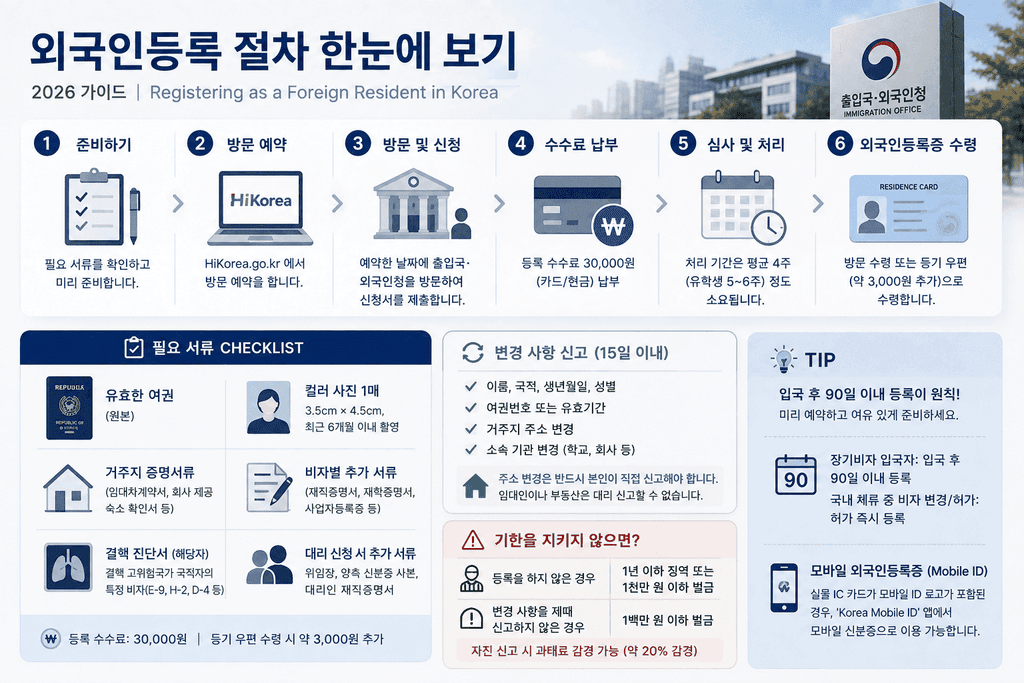
- 장기 비자로 입국한 경우: 입국일로부터 90일 이내 등록
- 국내 체류 중 체류자격을 변경·부여받은 경우: 허가를 받은 즉시 등록 (미루지 마세요)
특히 학기 초에는 출입국·외국인청이 매우 붐비므로, 90일이 다 되어갈 때까지 기다리지 말고 하이코리아 방문 예약을 미리 잡는 것이 좋습니다.
제출 서류
- 외국인등록 신청서 (출입국·외국인청 비치 또는 하이코리아 온라인)
- 유효한 여권
- 최근 6개월 이내 촬영한 컬러 사진 1매 (3.5cm × 4.5cm)
- 체류지 증빙 서류 (임대차계약서, 회사 제공 숙소 확인서 등)
- 체류자격별 추가 서류 (재직증명서, 재학증명서, 사업자등록증 등 — 비자 종류에 따라 크게 다름)
- 결핵 고위험국가 국적자의 경우 일부 체류자격(E-9, H-2, D-4 등)에서는 결핵 검진서 필요
- 등록 수수료: 30,000원 (등록증을 우편으로 받고자 하는 경우 약 3,000원 추가)
- 대리 신청 시: 위임장, 위임자·대리인 신분증 사본, 대리인 재직증명서
처리 기간은 통상 약 4주 정도이며, 유학생의 경우 5~6주까지 소요될 수 있습니다. 은행 계좌나 휴대폰 개통을 위해 등록증이 필요하다면 이 기간을 미리 감안해두는 것이 좋습니다.
변경 사항 신고
등록 후 아래 사항이 변경되면 반드시 신고해야 합니다. 2026년 기준 신고 기한은 변경일로부터 15일 이내입니다.
- 이름, 국적, 생년월일, 성별
- 여권 번호 또는 유효기간
- 체류지(거주지) 주소
- 소속 기관 변경 (학교, 회사, 단체 등)
임차인(세입자)이라면 특히 주의하세요: 이사 시 체류지 변경 신고는 본인만 할 수 있으며, 임대인이나 부동산 중개인이 대신 신고할 법적 권한이 없습니다. 계약 과정에서 중개인이나 집주인이 “알아서 처리해줄 것”이라고 생각하지 마세요. 하이코리아 온라인 또는 관할 구청·출입국청 방문으로 간단히 처리할 수 있지만, 반드시 본인이 직접 해야 하는 절차입니다.
신고 기한을 놓쳤을 때의 불이익
- 등록 자체를 하지 않은 경우: 1년 이하의 징역 또는 1천만원 이하의 벌금
- 변경 신고 기한을 놓친 경우: 1백만원 이하의 과태료
- 적발되기 전에 스스로 신고하면 행정절차법상 약 20% 정도 과태료 감경을 받을 수 있으므로, 기한을 놓쳤더라도 숨기기보다는 자진 신고하는 것이 유리합니다.
모바일 외국인등록증 (2026년 업데이트)
2025년 1월 처음 도입된 모바일 외국인등록증은 2026년 들어 단순한 신기술을 넘어 실질적으로 쓸모 있는 수단으로 자리 잡았습니다.
작동 방식:
실물 IC 외국인등록증을 모바일 신분증(Korea Mobile ID) 앱에 등록한 디지털 버전으로, 국내에서 신분 확인 용도로 실물 카드와 동일한 법적 효력을 가집니다.
필요 조건:
- 본인 명의로 개통된 Android 8.0 이상 또는 iOS 16 이상 스마트폰 (법인폰, 블랙베리, LG U+를 제외한 대부분의 알뜰폰 요금제는 사용 불가)
- 모바일 신분증 로고가 표시된 실물 IC 외국인등록증
- 출입국·외국인청을 방문해 설정하는 4자리 PIN 번호
신청 방법:
전 과정을 스마트폰으로 진행합니다 — Korea Mobile ID 앱 다운로드, 본인 인증, NFC로 실물 카드 태그, 안면 인식, PIN 설정 순서로 이루어집니다.
참고 사항:
- 하나의 기기에만 등록되므로 휴대폰을 바꾸면 재등록해야 합니다
- 유효기간은 실물 등록증의 유효기간을 그대로 따릅니다
- 일부 오래된 시스템이나 소규모 기관에서는 아직 인식하지 못할 수 있으니, 특히 처음 방문하는 은행이나 기관에서는 실물 카드를 함께 지참하는 것이 안전합니다
- 앱 인터페이스는 현재 한국어만 지원됩니다
등록증과 함께하는 한국 생활
외국인등록증(옛 명칭으로는 여전히 익숙한 ‘외국인등록증’/ARC)은 한국 내 주요 신분증 역할을 합니다. 실물이든 모바일이든 다음과 같은 경우에 필요합니다:
- 은행 계좌 개설
- 임대차 계약 체결
- 휴대폰 개통
- 운전면허 취득
- 대부분의 한국 앱·웹사이트 본인 인증
한국을 완전히 떠날 때는 출국 전 공항 출입국 사무소에 등록증을 반납해야 합니다.
서울 임대 전문 중개인이 전하는 실전 팁
매일 외국인 세입자분들과 함께 일하다 보면, 등록 절차 자체가 복잡해서라기보다는 이사 일정과 맞물리면서 불필요한 스트레스가 생기는 경우를 자주 봅니다. 계약 전에 알아두면 좋은 점 몇 가지를 정리했습니다:
- 임대인은 계약을 확정하기 전에 외국인등록증(또는 최소한 신청 진행 중임을 증빙하는 서류)을 요구하는 경우가 많습니다. 등록증이 국내 법적 주소와 연결되어 있기 때문입니다.
- 처음 등록하면서 동시에 집을 구하고 있다면, 임대차계약서 자체가 등록 신청 시 체류지 증빙 서류로 사용 가능한 경우가 많으므로 둘 중 하나가 끝날 때까지 기다릴 필요는 없습니다.
- 새 주소로 변경 신고를 마쳤다면 확인 서류를 꼭 보관하세요. 은행, 통신사, 그리고 이후 임대인이 요구하는 경우가 있습니다.
외국인으로서 서울에서 임대차 계약을 진행하면서 이런 행정 절차까지 꼼꼼히 챙겨줄 사람이 필요하시다면, 집을 구하는 과정과 함께 이런 부분까지 함께 도와드리고 있습니다.
유용한 참고처
- 하이코리아 (HiKorea) — 방문 예약, 신청, 변경 신고
- 외국인종합안내센터: ☎ 1345
- 관할 출입국·외국인청 (등록된 체류지 기준으로 결정)
본 가이드는 2026년 9월 기준 공개된 출입국 관련 규정을 정리한 것입니다. 세부 요건과 수수료는 변경될 수 있으므로, 방문 전 반드시 하이코리아 또는 관할 출입국·외국인청을 통해 본인의 체류자격에 맞는 최신 정보를 확인하시기 바랍니다.
Sources used: